VeebarTech
01A VeebarTech product, built for people who back companies

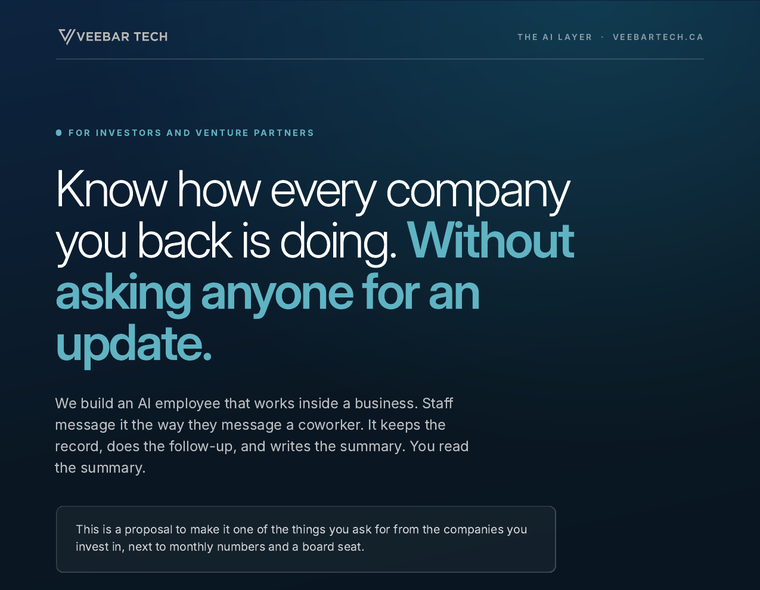
Know how every company you back is doing.

Without asking anyone for an update. We build an AI employee that works inside an operating business. Staff message it the way they message a coworker. It keeps the record, chases the follow-ups, and writes the summary. You read the summary.

To be clear about what this page is: it describes a system we install inside the companies you back. We are not raising money and this is not a pitch for investment in VeebarTech.

02What it is

The AI Layer, in one paragraph.

The AI Layer is an AI employee that Veebar Tech Inc. installs inside an operating company. It is hired the way a person is hired. It gets a company email address and a seat in the team chat, and it answers from the company's own price list, past jobs and files rather than from the internet. Staff message it in normal words while they work. Every message it handles leaves a record, and every morning it turns those records into a plain summary of what happened and what is stuck.

For an investor, the useful part is the last sentence. Every company you back files the same summary, under the same headings, on the same day. Five companies take ten minutes to read instead of five translation jobs.

03The problem

You back a company. Then you wait.

The report comes a month after the month ended, and it is written by the same people it is reporting on. In between, you hear about a problem once it is big enough to be worth telling you about.

That is not anyone hiding anything. A small team has nobody spare to write down what happened today. So it does not get written down, and by the time you can see it, it is old.

04How it starts

Onboarded like anyone else.

There is no new software for the company to buy and nothing for the team to install.

STEP 1

Give it an account

An email address and a seat in the company chat, same as a new hire. Nobody installs anything.

STEP 2

It reads the company

Its own price list, its own past jobs, its own way of doing things. It answers from the company's real files, not from the internet.

STEP 3

Staff start talking to it

In the app they already use all day. There is no new system to learn and no week of training.

05What it actually does

Twelve things, in plain words.

Every one of these is something a person in the business already does, or already fails to do. It does not add a job to anyone. It sits on the work that is already happening and writes it down.

01

A summary of yesterday, every morning

Before anyone starts work it writes up the day before: what each person worked on, what moved forward, what did not. It reads the real sources, not a status form.

  • A picture of the business every morning, and nobody was asked for an update.
  • The same summary from every company you back, in the same shape.
  • It says whether the company is ahead or behind on what it said it would do this quarter.
02

It tells you what is stuck, and for how long

When a job stops moving it names the job, says how many days it has been sitting, and says who it is waiting on. It keeps saying it until the job moves or somebody decides to drop it.

  • Problems surface in days instead of at the next quarterly meeting.
  • The team gets the nudge before you have to give it, so it stays their win.
  • A short list of what is genuinely blocked, not a long list of everything in progress.
03

Buying things goes through it

Whoever needs to buy something messages the AI. It writes the request into the purchase list, checks it against the job for the wrong size, wrong amount or a duplicate, and passes it to whoever does the buying.

  • One list of everything the company has asked to buy, with who asked and why.
  • Spend by job and by month, without anyone keeping a spreadsheet alive.
  • Fewer wrong orders, because every request is read once more before the money leaves.
04

Nothing quietly gets dropped

Anything anyone promises gets written down and comes back on a date. A promise to a customer, a deadline, a thing to check again in three weeks.

  • Promises to customers get kept, which is most of what a reputation is.
  • Slow work does not die in the gap between two busy weeks.
  • When something has been open too long it hands it to the owner to decide.
05

Every phone call gets read

Every call into the business is written out and read. It marks the calls where a customer asked for something and did not get it, and quotes the exact line where it happened.

  • The money that walked out over the phone, named, with the sentence that lost it.
  • The real top three reasons customers hang up, instead of a guess.
  • Nobody has to sit and listen back to calls to find out.
06

Meetings turn into a list of who owes what

Send it the recording. It returns what was decided, who agreed to do what, and by when. Those items join the same follow-up list as everything else.

  • Decisions are written down the same day, so nobody has a different memory a month later.
  • Action items get chased instead of sitting in one person's notebook.
07

Anyone can ask the company a question

"What did we quote this customer last year?" "What do we do when someone claims warranty?" It answers from the company's own records and its own memory of the work.

  • What the company knows stays in the company when somebody leaves.
  • A new hire gets up to speed by asking questions at any hour.
  • Two people give a customer the same answer, because they read it in the same place.
08

The monthly report writes itself

On the same day every month it pulls the real numbers out of the systems that hold them, writes the report, files it and sends it. Nobody is asked for a figure.

  • The report lands on time every month, in the same shape, so months compare honestly.
  • The numbers come from the source, so none of them are typed in from memory.
  • It costs nobody a day.
09

Small changes happen by message

"Put the new price list on the website." "Add the holiday hours." "Write this job up as a case study." It makes the change and it is live in minutes.

  • Ten-minute jobs stop sitting in a queue for two weeks.
  • The company stops paying an outside supplier to make a small edit.
10

It watches for money the company can claim

Grants, rebates, tax credits and tenders the business qualifies for. It checks the sources every day and reports only genuine changes, with the closing date attached.

  • Funding the company qualifies for and would otherwise never hear about.
  • Deadlines arrive while there is still time to apply, not the week they close.
11

It checks its own work

Every job it runs on a schedule is watched by a second check that runs daily. When a password expires or a connection breaks, an alarm goes off the next morning.

  • You find out it stopped working the next day, not three months later when you needed the report.
  • This is the reason these systems are still running a year after they were switched on. Most are not.
12

One view across everything you back

Each company's AI sends the same short summary into one place, on the same day, under the same headings.

  • Every company you back, side by side, measured the same way.
  • You can see which ones are moving and which are stuck without learning five reporting styles.
  • A company that stops reporting is obvious the moment it happens.
06The evidence

It is already running. This is not a demo reel.

We run this system on our own company every day, and pieces of it run for the companies we look after. Every number below was counted off the live system on 29 August 2026. None of them are estimates.

1,142

messages handled in chat

From our own team over 110 days, in normal language. Voice notes, photos and documents included.

630

customer calls read

Every call into one client's business, written out and scored for what the caller wanted.

117

articles published

Researched, written and put live on client websites with nobody in the loop.

212

funding leads found

Across 11 government sources checked daily. 159 have already been passed on with their deadlines.

90

jobs tracked to the end

Standing commitments that come back on a date instead of being forgotten.

28

jobs that start themselves

Daily, weekly and monthly work that nobody has to remember to begin.

11

checks every morning

Each one watches a different automatic job and raises an alarm the next day if it stopped.

1,398

tests, run daily

They check the AI still behaves the way it was told to. There were 58 of them in June.

Counted, not estimated

Every figure was read off a log file or a database on the machine that runs the system, on 29 August 2026.

Ours and our clients'

The chat, tracking, funding, self-check and test figures are from our own company. The calls and the articles are client work that we run.

What is not here

No revenue, no contract values, no client names. We are happy to walk through any single number on a call.

07One worked example

630 phone calls nobody had time to listen to.

One client gets a lot of calls. Over seven months the AI wrote out every single one and read it. 153 of those calls rang out. It found each one, read what the caller had wanted, and named the 105 who were ready to spend money. It also found the one thing customers asked for most often, by counting how many times they said it.

None of that was a guess, and nobody had to sit and listen back. The owner now knows which hours need somebody on the phone, and what to have ready when they pick up.

08Why a fund would ask for this

It changes what you can see, and when.

A live picture, not a monthly one

You stop finding out in arrears. The state of the business is readable any morning you want to read it.

Every company reported the same way

Same headings, same measures, same day. Comparing five companies stops being a translation job.

Problems while they are still small

Something stuck for six days is cheap to fix. The same thing found at the next board meeting is not.

The team spends its time on the work

Not on writing up the work. You invested in what they do, and this is how more of their week goes into doing it.

09What it asks of the company

Very little, and none of it is new software.

  • An email address and a seat in the chat app they already run.
  • Access to the files and tools they already use. Nothing is replaced.
  • A setup period where it learns how that company actually works.
  • One person inside the company who answers its questions while it settles in.
10What we are asking

Two ways to start, and both of them are small.

OPTION 1

Tell us if this belongs on your list

A conversation about whether this is something you would ask of a company before you back it, and what is missing from it if not.

OPTION 2

Pick one company and watch it run

We install it in one business you already back. You see it working before anybody signs anything.

11Questions

The things people ask before the call.

What is the AI Layer?

The AI Layer is an AI employee that VeebarTech installs inside an operating company. It has a company email address and a seat in the team chat, it answers from the company's own files rather than from the internet, and it keeps a record of everything it handles. Every morning it turns those records into a written summary of what happened and what is stuck. It is not a chatbot on a website and it is not a subscription the company logs into.

Does it replace anyone on the team?

No. It does not do anyone's job and it is not a headcount argument. It does the writing down that surrounds the job, which in a small company is the part that never gets done. The team keeps doing their own work and the paperwork builds itself on the side. Our whole line about this is "you, amplified", and we mean it literally.

Who is this actually for?

People who own or back operating companies with staff. Holding-company owners, search-fund and ETA buyers, angels who sit on boards, family offices, and operating partners at small funds. It matters most when the business has between roughly 8 and 100 people, because that is the size where there is real work happening and nobody spare to document it.

How is this different from a dashboard or a BI tool?

A dashboard shows you numbers that somebody else already entered. The gap in a small company is that nothing gets entered. This works the other way around: staff message it to get their own work done, and the record is a by-product of that. Nobody is asked to fill anything in, so the data exists whether or not anyone remembered.

What if the company already uses ChatGPT?

Most teams do, and it does not produce a record. A chat assistant has no access to the company's tools, no memory of the team between sessions, and no schedule, so it answers a question and forgets. The difference here is that it is installed into the tools the business already runs, it remembers the corrections it has been given, and it starts work on its own each morning without being opened.

How long does it take to get running?

The account and the chat seat take a day. The part that takes real time is the setup period where it reads the company's price list, past jobs and way of working, and where one person inside the business answers its questions while it settles in. We scope that per company on the call, because a 12-person contractor and a 60-person manufacturer are not the same job.

What does it report back to an investor?

A short summary on a fixed day, under fixed headings: what moved, what is stuck and for how long, whether the company is ahead or behind on what it said it would do this quarter, and the monthly numbers pulled from the systems that hold them. Every company you back files it in the same shape, so five of them read in about ten minutes.

Is one company's data visible to another?

No. Each company's AI is installed in that company's own tools and reads only that company's files. What travels to the investor is the summary that company files, and nothing else. Cross-company comparison happens on those summaries, not by pooling anyone's data.

Where does it not belong?

Businesses with no staff, since there is nothing to coordinate. Companies where the owner will not give it access to the real files, because then it is guessing. And anywhere the expectation is that it makes decisions. It writes down, chases and reports. People still decide.

What does it cost?

It is scoped per company rather than sold at a list price, because the setup work is what varies. The proposal covers what it does and what it asks of the company; the number comes out of a 20-minute call once we know the size of the business and which of the twelve things matter to you.

12The document

The full proposal, seven pages.

Written for someone deciding whether to ask their portfolio companies for this. It is the argument, the evidence and the two ways to start, in one file you can forward to a partner.

  • The problem and the idea, in two pages
  • How it gets onboarded, step by step
  • The twelve things it does, each with what you get
  • Every number counted off the live system, with where it came from
  • One worked example: 630 phone calls, 105 buyers found
  • What it asks of the company, and where it does not belong

Send me the proposal

Straight to your inbox as a PDF. One page of form, no call booked, no sales sequence.

On its way. Opening it here as well.

We email you the PDF. After that we may send one short email. We never sell or rent your email. Privacy policy.

Rather skip the form? Open the PDF directly.